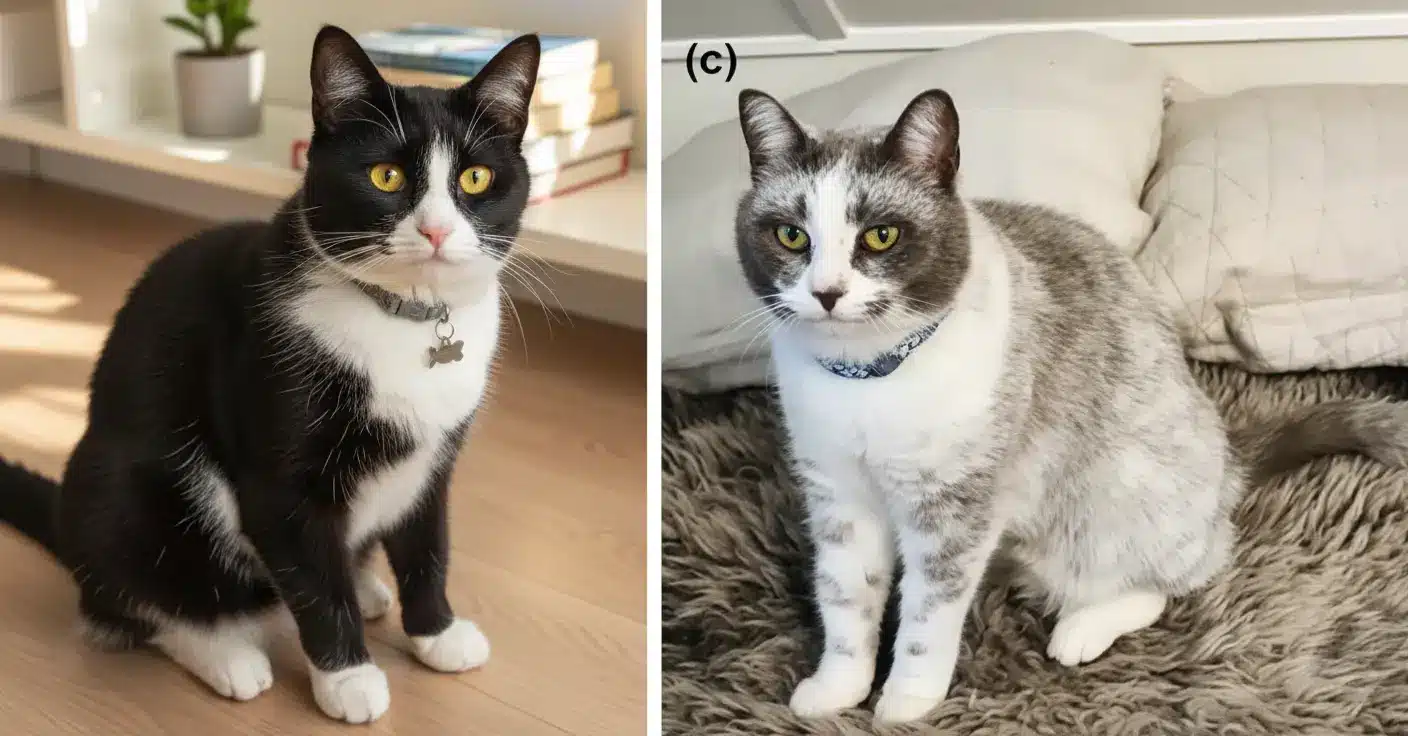
It turns out cats have been hiding some pretty purr-fect secrets. Thanks to a new study published in Nature Genetics, scientists have finally cracked several of the mysteries that have puzzled feline enthusiasts and geneticists alike for millennia. And while Finnish cats get the headline, the revelations unveil what makes all kinds of cats — from sleek house pets to jungle prowlers — genetically unique!
The Great Feline Genome Investigation
An international team of scientists embarked on a cat genome odyssey, analyzing five complete species: the domestic cat, the leopard cat, Geoffroy’s cat, tiger, and lion. This wasn’t some lazy afternoon in a cat café — it was a detailed, scientific peek into feline DNA. To add another layer of intrigue, the team further scrutinized three hybrid species:
- The Bengal cat, whose genetic mix is about 49.4% leopard cat and 50.6% domestic cat
- The Safari cat, a blend of 46.2% domestic cat and 53.7% Geoffroy’s cat
- The liger, showing 50.7% tiger and 49.3% lion
As Bill Murphy, a zoologist at Texas A&M University and a lead researcher, explained, “Our goal was to better understand how cats evolved and the genetic bases for the differences in traits between cat species.” The team eagerly took advantage of technology that lets us build more comprehensive feline genomic maps — with Murphy suggesting their findings will open doors for the study of feline diseases, behavior, and conservation. In short, a deeper knowledge of just what makes each kitty tick (or pounce, or lounge).
Steady Chromosomes and Surprising Simplicity
One of the burning questions: why do cats show relatively few complex genetic variations compared to other mammals?
The answer lies in their chromosomes. Researchers found that cat genomes display impressively few segmental duplications, especially compared to great apes. This leads to remarkable chromosomal stability. For example, there is not much difference between the chromosomes of a lion and a domestic cat. Just imagine — your tabby’s DNA has a familiar ring (or perhaps purr) to that king of the savanna!
In contrast, the genomes of great apes, including humans, tend to be more prone to shuffling and breaking apart, leading to unstable genetic regions. Such variability increases the risk of genetic diseases in some individuals, such as autism and other neurological disorders. So, while your cats might turn your living room upside down, their chromosomes are keeping things delightfully stable behind the scenes.
What Sets Cat Species Apart?
But don’t let the stability fool you — unique genetic tweaks still exist, setting each species apart. The intrigue centers on a particular region in the middle of the X chromosome, where most genetic rearrangements cluster. Scientists identified a repetitive element here, playfully named DXZ4. Bill Murphy detailed that evidence points to DXZ4 playing a crucial role in the genetic isolation (and thus speciation) of at least two cat species: the domestic cat and the jungle cat.
While the precise mechanisms remain elusive (no, even the world’s top zoologists can’t get cats to explain everything), comparing these feline genomes allowed the team to gauge how rapidly DXZ4 evolved in each species. The verdict: DXZ4 evolves faster than 99.5% of the rest of the genome. Due to this rapid mutation rate, the study convincingly demonstrates the probable link between DXZ4 and speciation in cats. In other words, when cats diverge, DXZ4 is speeding up that process, practically racing through the evolutionary tree.
Scent Genes and Natural Selection
Not content to stop at chromosomes, the team also sniffed out some revelations about olfactory genes. Thanks to the detailed genome sequences, they found broad variation between species. Some wild cat species, like the fishing cat, maintain genes that allow them to detect watery scents, crucial for catching prey. Meanwhile, domestic cats, not requiring such skills for survival (unless the food bowl is perilously empty), have lost many of these genes.
This variation hints at evolutionary trade-offs: cats living in the wild may retain particular scent-detecting genes essential for hunting, while domestic cats, with no such predatory pressure, drop the extras like yesterday’s litter.
As the researchers succinctly summed up, “When cat species are genetically different, those differences really matter.”
So next time your cat ignores your scent entirely, just remember: it’s all genetically justified. And thanks to science, we’re now several steps closer to truly understanding our feline friends — quirks, sniffs, and all!

John is a curious mind who loves to write about diverse topics. Passionate about sharing his thoughts and perspectives, he enjoys sparking conversations and encouraging discovery. For him, every subject is an invitation to discuss and learn.