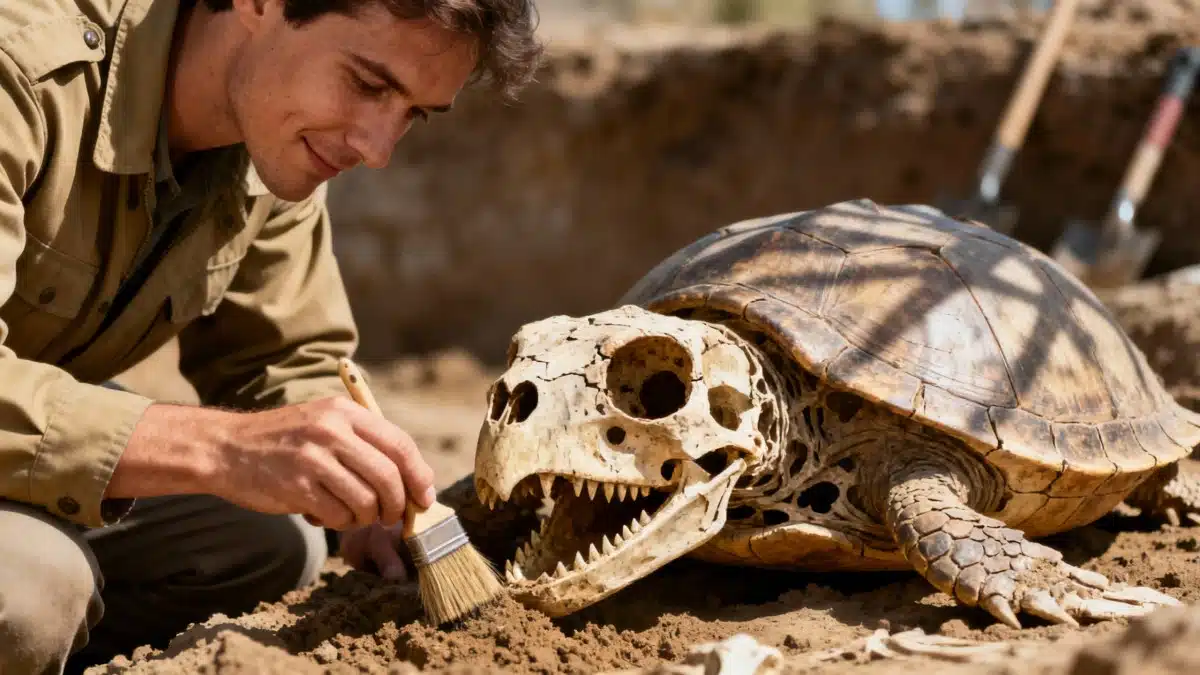
What swims and suctions its lunch, has a gorgeous fossil smile, and once cruised through the ancient rivers of Madagascar like it owned the place? If you guessed « a prehistoric turtle shocker, » you’re spot on. Scientists have just unveiled the rare fossil of a suction-feeding turtle so remarkable, it’s sending ripples through the world of paleontology.
A Unique Find in Dinosaur Country
In 2015, as Walter Joyce and his team from the University of Fribourg explored the fossil-rich lands of Madagascar, their attention was focused squarely on dinosaurs and crocodiles. Yet what they stumbled upon was, by all accounts, a once-in-a-lifetime discovery—a nearly intact skeleton of an ancient turtle, measuring about thirty centimeters across. This shell-raising surprise dates back some 70 million years, to a time when the land was teeming with creatures much larger and (if we’re honest) probably a lot noisier.
Now officially named Sahonachelys mailakavava, this impressive reptile was more than just a pretty shell. As Walter Joyce put it, « The specimen is absolutely magnificent. It is also among the best-preserved late Cretaceous turtles known from all southern continents. » In every respect, Joyce and his team consider it an exceptionally rare find.
Faces Made for Suction—Hold the Straw
But what truly sets Sahonachelys mailakavava apart isn’t just its impressive age or state of preservation—it’s how it ate. The fossil boasts a flattened skull and a rounded mouth, features that have led scientists to a fascinating conclusion. Based on the facial anatomy, they believe this small reptile didn’t spend its life munching on leaves or gnawing on hard shells. Instead, it likely fed by suction: rapidly opening its mouth underwater to draw in sudden, gulp-sized mouthfuls of water and whatever unsuspecting prey happened to be swimming inside.
- Specialized feeding method noted: suction
- Broad circular mouth allowed it to gulp water (and prey!)
- Probable menu included plankton, tadpoles, and fish larvae
The research team highlights that this form of underwater feeding is highly specialized. They describe the process: « The animal rapidly opens its mouth and expands its throat to almost inhale a large volume of water, within which swim several small prey. »
But wait, there’s more—the turtle’s tongue anatomy also points to this lifestyle. Its remarkably broad tongue bones suggest the evolution of strong muscles, likely enabling it to rapidly expand its throat and create a powerful, prey-sucking vacuum. Talk about dinner in a gulp!
A Reptilian Dynasty with a Colorful Past
Sahonachelys mailakavava wasn’t some biological loner. It belonged to the Pelomedusoidea family, a group that today includes South American and Malagasy river turtles. While the group might strike us as a bit limited nowadays (let’s face it, no one is winning diversity awards here), these fossil records tell a different story. As Joyce notes, « Although the group is not particularly diverse today, fossil archives show it was much more varied in the past, conquering multiple landmasses. » At one point, these turtles could be found basking on shores across entire continents.
Extinction? Maybe Not So Fast…
The story of Sahonachelys mailakavava remains shrouded in a few mysteries—when exactly did this species emerge? Why did it vanish? On these questions, the researchers admit defeat. However, Walter Joyce suggests that this ancient turtle may have done what so few managed to do: survive the great extinction event that wiped out the dinosaurs and closed the Cretaceous chapter some 66 million years ago.
A turtle that could stare down extinction with a flattened skull and a broad, easy grin? If true, that’s something even a dinosaur might tip its hat to (if it had hats, or the inclination).
Science writer Brice, whose passions orbit space and paleontology, has been bringing discoveries like this to readers of Sciencepost for nearly a decade—proving there’s always something new (or very, very old) to uncover. So next time you see a turtle, just imagine its ancestors vacuuming up lunch in the ancient rivers of Madagascar. Now that’s a dinner date worthy of history!

John is a curious mind who loves to write about diverse topics. Passionate about sharing his thoughts and perspectives, he enjoys sparking conversations and encouraging discovery. For him, every subject is an invitation to discuss and learn.