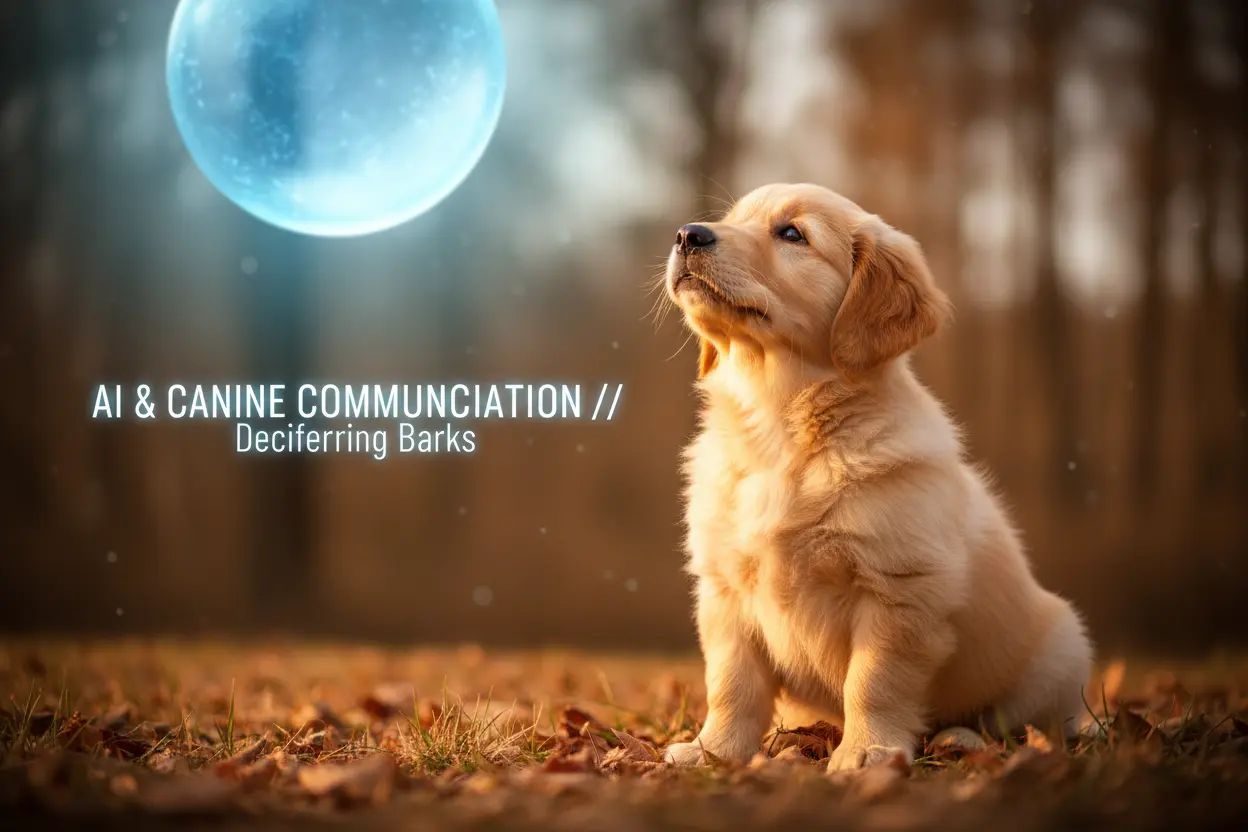
Ever caught your dog in the middle of an epic barking session and wished you could just pull out Google Translate and get the lowdown? Science is finally barking up the right tree. Researchers may be nearing a breakthrough that helps humans decipher what our canine companions are really trying to say—thanks, in part, to artificial intelligence.
The Bark Behind the Breakthrough
It turns out, even expert animal behaviourists, who might pride themselves on being fluent in « dog, » admit they’re still often at a loss when it comes to pinning down all the nuances in a dog’s vocal repertoire. But this is on the cusp of changing, courtesy of machine learning. A team of researchers is currently developing AI-based tools that could dramatically improve our understanding of what man’s best friend is actually trying to communicate.
However, this isn’t their first foray into canine linguistics. Many attempts have run face-first into a familiar problem: an alarming lack of data. Language models, whether intended for humans or pups, can’t simply guess the meaning of sounds; they need robust, real-life examples to learn from. Tuning an algorithm to pick up on the meaning of « wooof » or « grrr » without any reference is as futile as expecting a toddler to read before they’ve seen a single letter.
For human languages, examples are everywhere—books, movies, awkward family reunions. But animal vocalizations are far tricker to mine. « From a logistical perspective, animal vocalizations are much harder to prompt and record, » says Artem Abzaliev, the lead author of the study. Dogs, unfortunately, don’t keep diaries, and pressing play on a recorder is rarely enough to capture the action as it happens.
Repurposing Human Tech for Canine Chatter
Faced with the data drought, a team from the University of Michigan devised a clever workaround: recycling a machine learning model built for human speech. « By using language processing models initially trained on human speech, we’ve opened a window onto the nuances of dog barks, » explains co-author Rada Mihalcea.
Thanks to this approach, they’ve been able to take advantage of years of development in voice recognition. There’s already a smorgasbord of models that identify timbre, accent, intonation—and even spot emotions like frustration, gratitude, or disgust in human audio. « These models are capable of learning to encode incredibly complex human language patterns, and we wanted to see if we could leverage that for interpreting dog barks, » says Abzaliev.
The experiment began with Wav2Vec2, a speech model initially made for humans. The team fed it a dataset of recordings from 74 dogs, covering a spectrum of breeds, ages, and sexes. To keep life interesting (and scientific), these barks were recorded in various contexts: during play, when detecting a small intruder, in defense mode, and during social interactions. Using this diverse soundscape, Abzaliev was able to tweak the importance of the model’s artificial neural connections and their biases.
Once the process wrapped up, the AI churned out representations of the dogs’ acoustic data—then interpreted them. Upon review, the model had correctly categorized the barks (play, anxiety, calls for attention, pain, frustration, and more) about 70% of the time. Not perfect, but a solid leap forward compared to models trained solely on animal noises. « It’s the first time human speech-optimized techniques have been used to crack animal communication, » says Mihalcea—and she’s clearly thrilled.
From Dog Barks to a Whole Animal Kingdom?
But the story doesn’t end with a wag of the tail—there’s a broader implication. These results suggest the structures underlying human language could be a blueprint for analyzing animal vocalizations, possibly even for other species. Once mature, this system could become essential for ethologists—scientists specializing in animal behaviour.
These researchers often rely on vocalizations to study social dynamics, behavioural quirks, and cognitive capabilities in their favourite species. A tool like this could help them spot nuances they might otherwise miss… or just handle the grunt work. Imagine a team analysing primate calls in the depths of a chaotic jungle. Instead of sifting through endless audio clips and labeling each shriek, an AI model could do the heavy lifting, picking out patterns and relationships at record speed.
Woofs, Wags, and What’s Next
The team’s paper doesn’t dive into the futuristic possibilities, but it sparks the imagination to think: perhaps one day, generative AI systems will not only decode, but create animal-specific sounds to convey tailored messages. Today, that’s pure science fiction—a sort of “Siri for Spot” fantasy. Still, it opens up hopes that AI could help us one day “chat” with loyal companions, untangle whale songs, or even unravel the mysterious orca-boat rivalry.
Of course, let’s not forget some crucial observations from real animal lovers:
- Dogs communicate with much more than just barking—otherwise, they’d bark all day long.
- Humans don’t only use words either; there’s a world beyond sound and math (just ask Mr. Tesla, apparently).
- Unlike humans, animals may have the advantage of less complexity: you’re not as likely to find animal vocalizations disguising deceit or trickery.
- Animal language is mostly learned young, especially from the mother, in healthy environments—and these factors matter just as much when exploring animal cognition as they do with humans.
Maybe humans shouldn’t ask deep learning to translate animal to human (in what language—English, French, Mandarin?) in just two years. But with a little patience, a few treats, and some cutting-edge AI, our dream of chatting with our furry friends might not be so far-fetched after all!

John is a curious mind who loves to write about diverse topics. Passionate about sharing his thoughts and perspectives, he enjoys sparking conversations and encouraging discovery. For him, every subject is an invitation to discuss and learn.