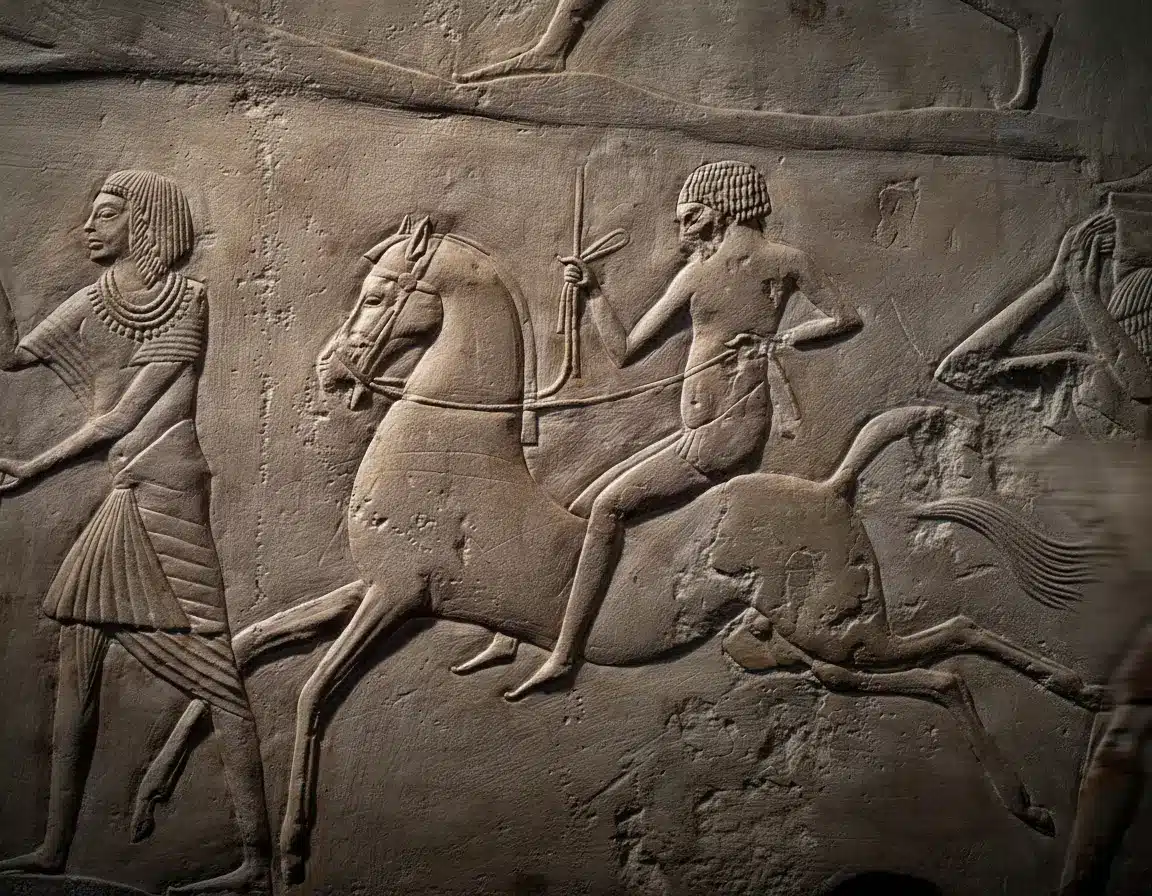
Imagine a world where the wildest thing you could spot galloping across a windswept plain was, well, a human. Thanks to some fascinating new archaeological discoveries, it turns out our ancestors may have hopped on horseback long before pharaohs started carving horseman reliefs in ancient Egypt. And the trailblazers? An enigmatic group of ancient nomads called the Yamnas.
Riding Back in Time: The Yamnas’ Gallop Across Europe
Recent excavations have unearthed compelling evidence that horseback riding began not with Egyptian or Mesopotamian royalty, but much earlier in the sweeping plains of southeast Europe. While the very first depictions of riders—for instance, that limestone relief in Horemheb’s tomb at Saqqara, Egypt—only date to the Bronze Age, actual horse riding might have kicked off 1,500 years before such images trotted into history.
The real stars here are the Yamnas. About 5,500 years ago, this nomadic people abandoned the eastern European plains and headed west—on foot, or perhaps, on horseback. In a twist that would do any equestrian proud, their apparent adoption of horse riding could have given them a serious edge in their prehistoric trek across the continent.
Bones Don’t Lie: The Archaeological Evidence
How do we know the Yamnas were likely riders? Archeologists discovered 24 Neolithic skeletons in Hungarian, Romanian, and Bulgarian burials showing clear physical signs linked to regular riding:
- Lesions in their lower vertebrae
- Unusually dense pelvises
- Distinctive striations on their femurs
Most notably, five Yamna individuals in tombs dated between 4,500 and 5,500 years old revealed multiple such indicators. And they weren’t alone—four others, probably from Yamna-influenced cultures, showed the same wear and tear. It’s the oldest physical evidence yet found for horseback riding, even though researchers (wisely) don’t claim the Yamnas were the very first to hop on.
For additional drama, these discoveries are set amidst kurgans—those quintessential burial mounds—scattered by the tens of thousands across southeast Europe, monuments erected by the Yamnas and their kin.
How Did They Ride? Horses, Gear, and Real-Life Challenges
Dismissing the ancient-cavalry charge imagery for a moment, scientists believe it’s unlikely Yamnas were fearsome horse-warriors. Their horses were probably too skittish for battles (leave the heroic, genetically selected war stallions to later millennia). Instead, riding probably gave the Yamnas a massive boost in managing livestock and mobility—a key ingredient in their widespread success as pastoralists.
A few other neat tidbits:
- Yamna horses were smaller, broad-torsoed, and stocky, reminiscent of today’s Przewalski’s horses, according to researcher Martin Trautmann.
- Forget plush saddles and shiny stirrups: the early riders most likely used mats laid on horse backs. Saddles weren’t invented until after 1,000 BCE, and stirrups even later.
- Ancient depictions from Egypt and Mesopotamia show riders sitting far to the rear on horses, holding long reins attached to harnesses. Volker Heyd, a leading archaeologist on the study, points out that this odd-looking style made it easier to stay upright and guide their mounts.
Archaeological proof for the horsey kit is hard to come by because it was mostly made of perishable materials. As a result, early equestrians had to make do without some of the gear modern riders take for granted.
From Herds to Languages: The Yamnas’ Lasting Legacy
According to Kristian Kristiansen from the University of Gothenburg, who didn’t participate in this particular study, these new findings settle a long-standing debate: were the Yamnas true riders, or just milk-and-meat gatherers? He calls it a breakthrough—a long-awaited answer that was centuries in the making.
Why did this matter so much? For one, riding likely made it easier for the Yamnas to manage their unruly crowds of cattle, sheep, goats, and even other horses. There’s a strong hint that it was mobility, not mounted conquest, that best explains the explosive spread of Yamna culture. Still, some experts—like James Mallory of Queen’s University Belfast—think the jury is out on whether horses were sometimes used for war. The debate, in his words, is far from over.
Regardless of how many armed charges these proto-cowboys led, their ability to travel long distances left a remarkable imprint on Europe. The Yamna language is considered a forerunner of all Indo-European tongues, influencing the grammar and vocabulary of Greek, Latin, Germanic, Slavic, and Celtic families.
Linguists have even pinpointed connections in old words like “mother” or “father”—and in the reconstructed “éḱwos,” the ancestor of the Latin “equus,” meaning “horse.”
So next time you watch a galloping horse, spare a thought for those stocky, sturdy animals and their equally resilient riders who blazed trails—sometimes literally—across prehistoric Europe. The Yamnas may not have had saddles or fancy spurs, but they sure set us on a long and wild ride through history.

John is a curious mind who loves to write about diverse topics. Passionate about sharing his thoughts and perspectives, he enjoys sparking conversations and encouraging discovery. For him, every subject is an invitation to discuss and learn.