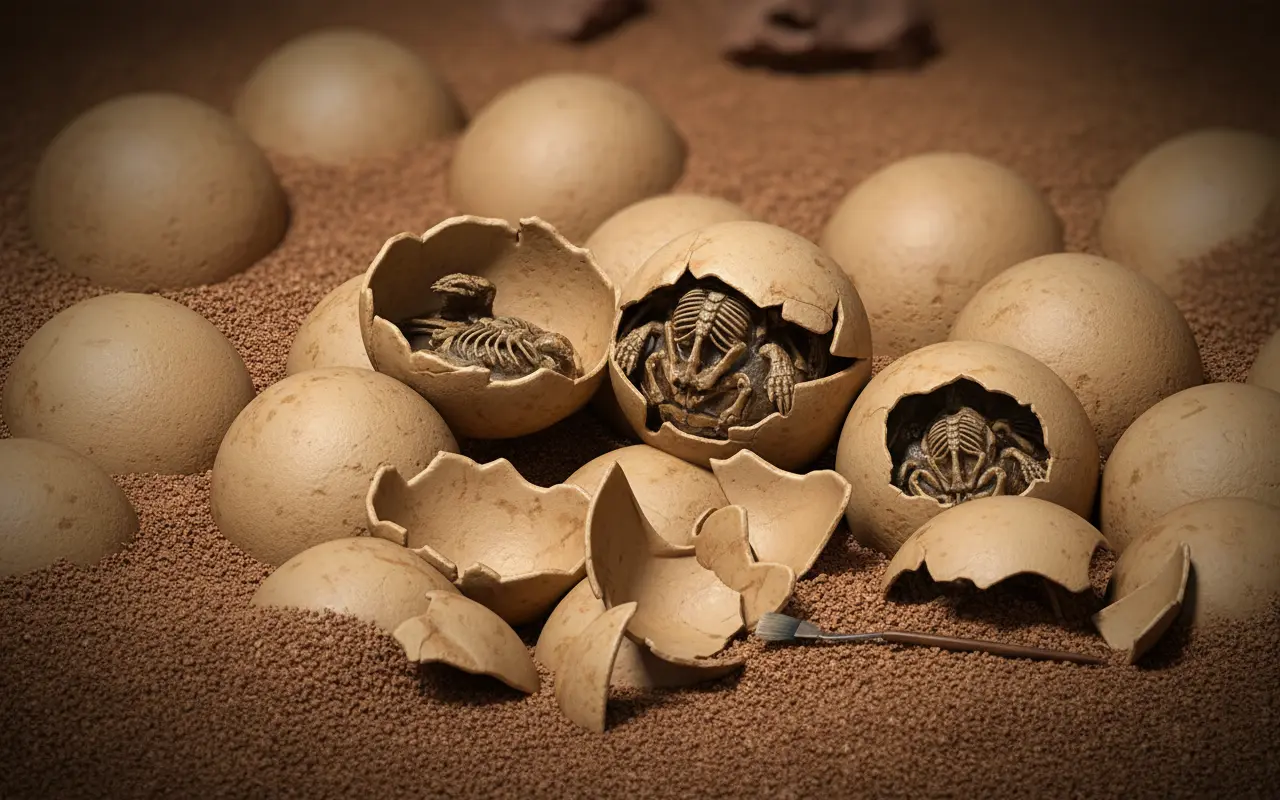
Picture this: you’re a farmer in Henan, China, tending to your daily chores, and you stumble across what looks like a black, slightly blue-tinged spherical rock, not much bigger than a tennis ball. Turns out, it’s not just a rock. It’s a fossilized turtle egg, and not just any egg—it’s 90 million years old, and still cradling its tiny, ancient embryo within. If that doesn’t tickle both your interest in science and science fiction, nothing will!
The Extraordinary Find: A Glimpse Into Deep Time
Finding fossilized turtle eggs from the Cretaceous period is something paleontologists only dream of. Their extreme fragility means most never survive the rough-and-tumble ride of the fossil record. An intact egg, housing its baby turtle in situ? Now that’s rarity on another level. Yet fate (and a sharp-eyed farmer) intervened: this near-miraculous specimen was unearthed quite by chance in Henan Province, instantly catching the attention of local scientists.
When researchers arrived on the scene, what they discovered left them awestruck. The specimen, with its black hue and a whisper of blue, was initially mistaken for a dinosaur egg. Not an unreasonable guess, considering that thousands of dinosaur eggs have been found in Henan over the last thirty years. But a closer look revealed a much more unusual story: this, in fact, was the giant egg of a now-extinct turtle.
The Story in the Shell
Present-day turtle eggs are small and their shells paper-thin, making life easy for hatching baby turtles. But this fossilized egg, clocking in at nearly six centimeters in diameter, breaks the mold—literally. Its shell is a staggering 1.8 millimeters thick—a true bodybuilder by shell standards. For comparison, that’s:
- Four times as thick as a Galápagos giant tortoise egg
- Six times thicker than your average chicken egg shell
- Only barely thinner than the average ostrich egg shell (2 millimeters thick), even though ostrich eggs are about 15 centimeters long!
So why was this shell so thick? According to the researchers, this extraordinary adaptation could have served many purposes, including:
- Preventing water evaporation in an era of intense drought (confirmed by plant remains from the same rock formation)
- Offering extra strength if the turtles dug their nests deeper than usual
Whatever the reason, the hatchling had its work cut out, needing unique talents (or sheer determination) to break free from such a sturdy casing.
Turtles That Time Forgot
The egg’s proud parent belonged to the Nanhsiungchelyidae, a now-extinct family of land-dwelling turtles that roamed alongside dinosaurs between 145 and 66 million years ago during the Cretaceous period. By reverse-engineering the egg’s size, scientists estimate the mother turtle’s shell would have been about 1.6 meters long, neck and head not included—making her as long as some people are tall!
Using modern scanning technology, the research team could peer through the eons and study the embryo inside, which was 85% developed and beautifully preserved. In fact, a tiny break in the shell might be evidence that hatching had begun. Strikingly, the embryonic turtle’s physiology was very similar to that of modern turtles—a reminder that, although times change, some recipes for survival don’t.
Key features, like the slightly squared-off and notched rear edge of the upper jaw, clinched the identification as a Nanhsiungchelyidae, according to Darla Zelenitsky, associate professor of paleontology at the University of Calgary and a co-author of the study. Even Raul Diaz, an evolutionary biologist specializing in reptile embryos (who wasn’t on the research team), confirmed that the ancient specimen’s bone structure echoed what can be seen today.
A Prehistoric Drama: Extinction and Legacy
The mighty Nanhsiungchelyidae loved dry land, digging their nests in the earth—a behavior that may have contributed to their downfall. When the non-avian dinosaurs met their catastrophic end 66 million years ago, these land turtles joined them, unable to survive the loss of vegetation following the asteroid impact. Their aquatic relatives, luckily, toughed it out. Since the disappearance of the Nanhsiungchelyidae, no turtle eggs with such imposing shells have ever been found, suggesting this feature may have been tightly linked to the unique, arid climate of their time—and not just a quirky evolutionary blip.
This remarkable discovery also represents the first instance where fossilized turtle eggs or a nest can be definitively attributed to a particular turtle species. The newly described specimen has already helped scientists identify more clutches belonging to the same extinct group. Paleontologists, including those like Tyler Lyson from the Denver Museum of Nature & Science and Jordan Mallon of the Canadian Museum of Nature (neither of whom contributed to the study), hope more fossils like this will soon see the light of day, unlocking secrets about ancient turtle nesting and their mysterious biology.
So, next time you see a turtle slowly ambling on land—or even just an egg in your fridge—remember: there’s a long, tough-shelled, and unexpectedly dramatic history behind them. Ancient turtles may not have the Hollywood glamor of dinosaurs, but in the evolutionary marathon, sometimes slow and steady leaves the most fascinating fossils.

John is a curious mind who loves to write about diverse topics. Passionate about sharing his thoughts and perspectives, he enjoys sparking conversations and encouraging discovery. For him, every subject is an invitation to discuss and learn.