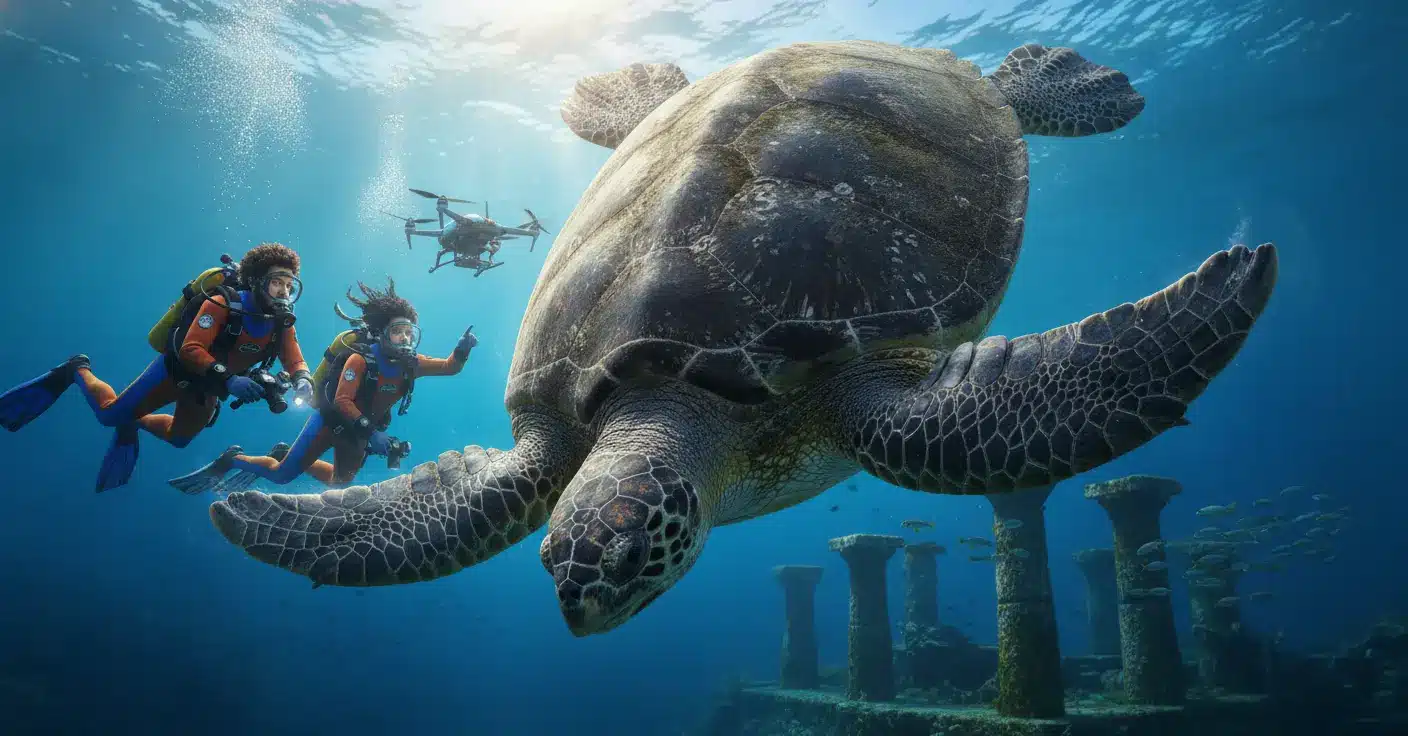
Imagine a sea turtle so colossal, it could compete with your family car for a parking spot. No, this isn’t a deleted scene from a science-fiction blockbuster, but a real blast from Europe’s deep past—in the form of a fossil recently uncovered in Spain. Scientists have just confirmed the largest sea turtle ever found in Europe, and it’s more impressive than anything you’d meet on a summer beach.
From Science to Sci-Fi: When Prehistoric Giants Swam European Seas
- The Cretaceous period, particularly its late phase, was awash with all sorts of marine reptiles and, notably, sea turtles. These giants navigated the subtropical waters that lapped at the shores of the ancient European archipelago.
- For years, Europe played the underdog when it came to turtle grandeur; the continent’s largest known marine turtle species measured a modest 1.5 meters long. Meanwhile, North America sported giants over three meters, like Archelon and Protostega.
- That imbalance just shifted: a newly identified species, Leviathanochelys aenigmatica, discovered by researchers from the Catalan Institute of Paleontology in northern Spain, steals the European crown with an estimated length of nearly four meters. That’s about the length of a compact car—though with far more style.
The Road to Discovery: A Lucky Hiker and a Puzzling Fossil
Back in 2016, a hiker exploring the Pyrenees near the village of Coll de Nargó stumbled across bone fragments. Officials and locals collected the remains, but for a while, they gathered dust. Fast forward to 2021: Oscar Castillo-Visa takes another look at these overlooked fossils and launches fresh excavations on the site.
The dig reveals the pelvis and the rear section of the shell from a gigantic sea turtle. Despite fragmentary remains, unique features convinced scientists this was a brand-new species—now officially named Leviathanochelys aenigmatica.
- The genus name, Leviathanochelys, merges the biblical sea monster Leviathan with the Greek word for turtle.
- The species name, aenigmatica, is a nod to its unusual, mysterious anatomy.
What Makes Leviathanochelys aenigmatica a Showstopper?
Leviathanochelys had an exceptionally broad pelvis. As Dr. Sandra Chapman, former curator of fossil reptiles and birds, observed: as the turtle’s shell got bigger, gaps between its bones did, too—likely making it lighter and less dense. But the real anatomical cliffhanger? Scientists identified a unique ‘accessory pubic process’—a bulging bone section on the side of the pelvis, a feature not recorded in any living or extinct turtle.
Muscle attachment marks on this oddity suggest it once helped anchor abdominal muscles. Dr. Ángel Hernández Luján explains this may have allowed the giant turtle to maximise its breathing capacity during deep dives, possibly making it the deep-sea diver of its day.
Comparisons hint at evolutionary links: its closest known relative is Allopleuron, a smaller extinct marine turtle found in Europe, the US, and Kazakhstan. However, Leviathanochelys is not closely related to the North American giants, suggesting turtle gigantism evolved independently multiple times. While researchers compared its pelvis size with that of Archelon to estimate its length, they stress that without a complete skeleton, there’s room for surprise—this beast could be a bit shorter or even longer than the projected 3.7 meters.
Turtles: From Small Wonders to Colossal Ancestors
The mystery of turtle evolution hasn’t been cracked yet—apart from the fact that, given time, some turtles get absolutely enormous. Today’s heavyweight record goes to the leatherback turtle, usually found in tropical seas (though some are daring enough to swim to Norway). The typical modern leatherback grows up to around two meters, with the exception of a Cardiff museum specimen approaching three. Still, these contemporary titans pale beside their ancestors.
- Ancient turtle giants first came to light in the 1870s, when Protostega gigas—measuring up to 4.2 meters—was described. Later, Archelon ischyros, another truly massive species, joined the family (and briefly stole the crown as the leatherback’s closest cousin—though that link is now debated).
- Modern understanding suggests these North American giants diverged from early sea turtle ancestors in the late Jurassic, over 145 million years ago, in the Western Interior Seaway that once split North America in two.
- While a few turtle fossils have surfaced in Morocco, Jordan, and Russia, concrete European evidence was limited and scattered—until Leviathanochelys aenigmatica surfaced to claim its place among the record-breakers.
So, next time you see a turtle, no matter how mighty it looks, remember: under that shell beats the heart of a lineage that once conquered continents and swam with prehistoric giants. Sometimes, the truth really is stranger—and bigger—than fiction.

John is a curious mind who loves to write about diverse topics. Passionate about sharing his thoughts and perspectives, he enjoys sparking conversations and encouraging discovery. For him, every subject is an invitation to discuss and learn.