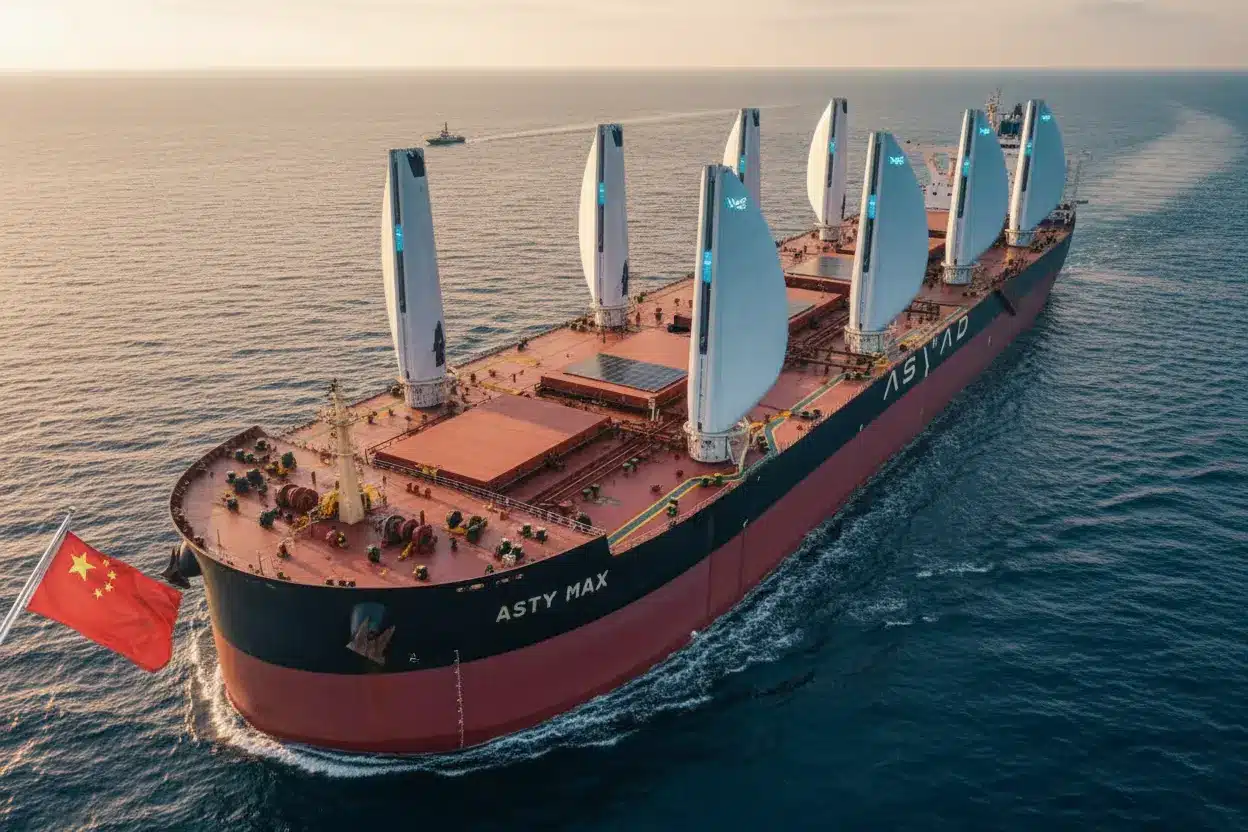
Are we seeing the winds of change in global shipping, or just a really stylish way to cut your fuel bill? Either way, what just happened aboard the Sohar Max could set a whole new course for the future of maritime transport. Let’s dive in—no life vests required.
The Rebirth of a Maritime Giant
Back in 2012, the Sohar Max was launched as one of the world’s biggest ore carriers, a true titan of the seas that sailed under the Valemax name. More than a decade later, this seafaring colossus is getting a dramatic plot twist. Forget pirates—Sohar Max is now making headlines thanks to the addition of wind-assisted propulsion technology, a move that promises to revolutionize not just its energy efficiency, but also its environmental impact.
High-Tech Sails: Tall, Bold, and Smart
October 2024 marked a turning point. At the COSCO shipyard in Zhoushan, China, Sohar Max was equipped with five massive rotating sails, each towering 35 meters tall and stretching 5 meters in diameter. These aren’t your grandpa’s dusty canvas sails, either. Developed by UK-based Anemoi Marine Technologies, these giant rotors are designed to catch and harness wind power, optimizing navigation and slashing reliance on fossil fuels.
The reduction in fossil fuel consumption is not just a technical win, but a considerable victory for sustainability, as CO2 emissions are set to decrease significantly. This is no minor tweak: Sohar Max’s new sails come with an innovative deployment and retraction system. Anemoi’s smart system allows the sails to be folded vertically when necessary. Why is that so clever? Well, it keeps cargo operations efficient and eliminates disruptions, proving that cutting-edge sail technology can actually harmonize with the needs of modern logistics. No need to choose between eco-friendly and effective—Sohar Max is now both.
- Five rotating sails, 35m high, 5m in diameter
- Installed by Anemoi Marine Technologies
- Fitted at COSCO, Zhoushan, China
- Sails retractable for cargo operations
Performance Gains and Real-World Testing
How does all this innovation translate into real-world changes? According to estimates, the use of these rotating sails could trim annual fuel consumption by up to 6%. For a vessel of Sohar Max’s size, that’s more than pocket change—it’s a significant saving for the ship’s operator. Even more crucially, carbon emissions are expected to fall by about 3,000 tons per year. That’s not just a feather in their cap; it’s a strong argument for investing in sustainable solutions for global shipping.
The experiment isn’t staying in the lab. After fitting the sails, Sohar Max set off on a trial voyage to Tubarao, Brazil, to put this high-tech system through its paces. These trial voyages will continue in the coming months. Why the field tests? They’re critical for assessing how well the sails perform in real sea conditions, and to keep fine-tuning the technology for maximum bang-for-buck (and, of course, maximum wind-in-your-sails).
A Team Effort for a Greener Industry
None of this would have happened without solid teamwork. This project is a textbook example of powerful partnerships, uniting Brazilian mining giant Vale S.A. (the vessel’s owner), Oman’s Asyad company, and the innovators at Anemoi Marine Technologies. Their joint vision? A thoroughly modernized fleet that achieves global emission reduction targets, all in line with major international standards like CII and EEDI/EEXI.
It’s not just Sohar Max making waves: rotating sails are quickly gaining popularity among ship owners keen on reaching carbon neutrality. Compact, punchy, and surprisingly efficient, this technology is giving ships the extra push they need to meet growing demands for better energy performance and lower emissions. Sohar Max’s retrofit is a statement—and a big one—in a global movement striving to transform maritime shipping into a cleaner and more sustainable sector.
- Up to 6% annual fuel savings
- CO2 emissions cut by roughly 3,000 tons per year
- Conforms with international emission reduction standards
With Sohar Max blazing a trail, it’s clear that shipping is charting a new course where technology and innovation don’t just improve efficiency, but genuinely reduce environmental impact. Should this technology prove successful in ongoing tests, we could soon see wind-assisted propulsion on a much broader scale—fundamentally redefining how we think about transporting goods across the globe. Fair winds ahead!

John is a curious mind who loves to write about diverse topics. Passionate about sharing his thoughts and perspectives, he enjoys sparking conversations and encouraging discovery. For him, every subject is an invitation to discuss and learn.