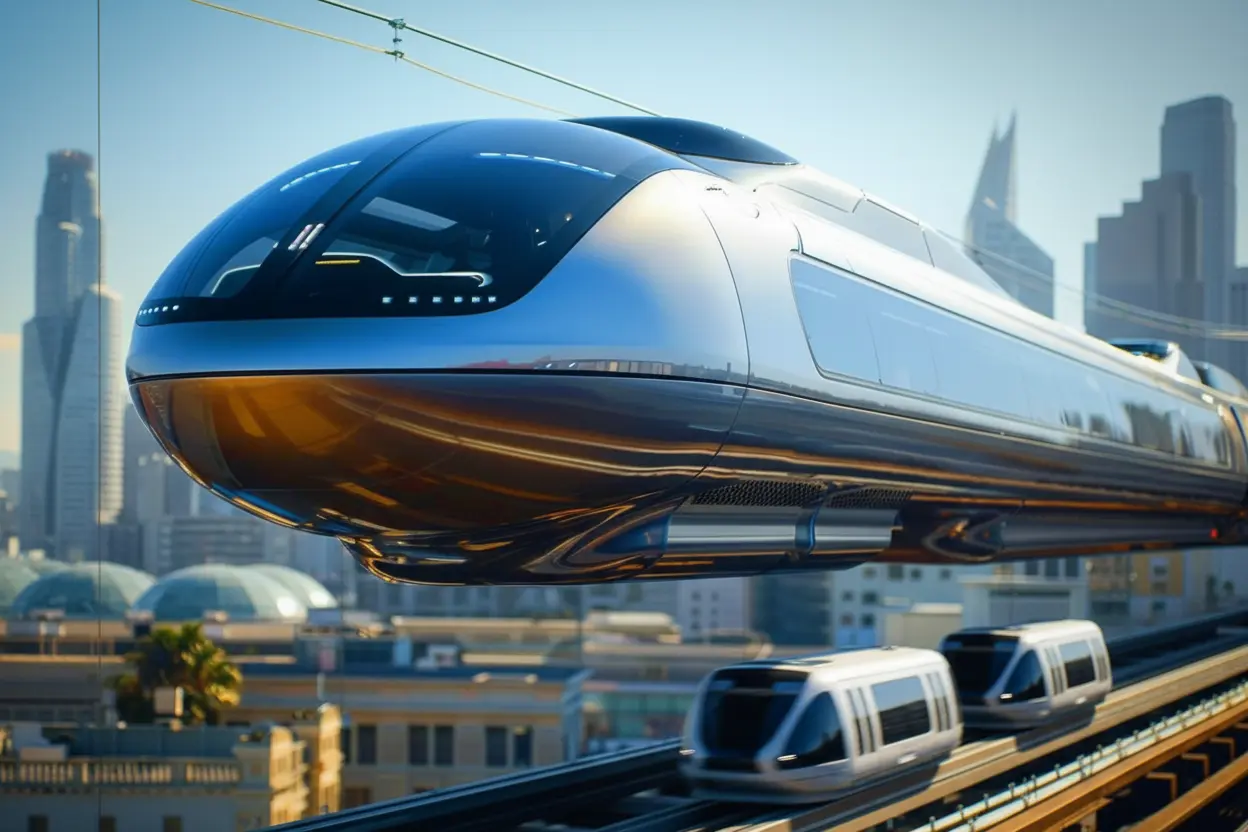
The future of travel might just be racing toward us from the East—faster than a speeding bullet, and perhaps, quicker than a commercial jet. China has made a major leap in supersonic Hyperloop development, and it could soon shatter everything we thought we knew about distance, time, and the romance (or drudgery) of cross-country train journeys.
Hyperloop Takes Shape in China
- China has accomplished a decisive step in the evolution of its supersonic Hyperloop—a system that fuses magnetic levitation (maglev) with low-pressure tube travel.
- The goal? Achieve speeds that approach—or even outpace—those of passenger airplanes.
- If successful, it could shake up our idea of commuting between megacities forever.
This isn’t just a concept. In Datong, Shanxi province, a 2-kilometer experimental track has taken shape. Here, the first full-scale Hyperloop maglev train has been put to the test. Picture it: a train floating thanks to magnetic levitation, leaving behind all track friction—while slicing through a low-pressure environment engineered to shrink air resistance to nearly nothing.
Encouraging Progress, Cloaked in Secrecy
Now, before you ask how fast this futuristic train actually goes, take a number—and get in line. Official speed figures are still under wraps, kept top secret like grandma’s pie recipe or, well, most things in advanced Chinese engineering. What’s clear, though, is that Chinese engineers are talking up some very encouraging results. They even call the trial a milestone on the road toward tomorrow’s railway.
Strategic Collaboration: Ambitions on the Fast Track
The initiative isn’t the product of a lone genius in a garage. It’s the baby of both the Shanxi provincial government and the China Aerospace Science and Industry Corporation (CASIC). For them, Hyperloop isn’t just an impressive showpiece—it’s a strategic cornerstone for the nation’s infrastructure.
Let’s talk ambition. The vision? Connections that slash travel times so radically that stopwatch sales might take a nosedive. For example, Beijing to Shanghai—a journey that currently takes 4 to 5 hours on high-speed rail—could, in theory, drop to just 90 minutes aboard the Hyperloop.
If these bold promises hold true, the system might completely revolutionize mobility within China’s mega-cities, with benefits rippling through the economy and daily commuting patterns. Still, before we get carried away booking future travel, it’s worth noting that there are still a few (dozen) unanswered questions.
The Big Questions: Cost, Integration, Reality Check
Building something this groundbreaking isn’t just a matter of laying down some shiny new rails. We’re talking colossal investments, and that’s before anyone even brings up an in-depth analysis of environmental and social impacts.
If you think transportation logistics are already complicated, think again. Integrating a supersonic Hyperloop means:
- Woven connections with the existing rail and infrastructure network
- Minimizing landscape disruption—a challenge worthy of an engineering soap opera
- Meticulous maintenance for an ultra-high-precision system
Then there’s the question of financial viability. The costs must make sense in the long run—which brings up a few practical dilemmas:
- Who will actually use these supersonic trains?
- At what price point will it be accessible enough to change travel as we know it?
So while China’s Hyperloop is busy breaking test track records and possibly the sound barrier (details pending), it’s clear the real race will be justifying its value over decades, not just minutes shaved off a journey.
Conclusion: China’s Hyperloop—An Inspiration, or a Challenge?
With its supersonic Hyperloop efforts, China isn’t just chasing records—it’s aiming to open a new chapter in transportation. Should the technological and financial limits be overcome, the country could well redefine what distance and travel time really mean, serving as a model (or perhaps, a wake-up call) for the rest of the world. In the meantime, travelers and dreamers alike can only watch and wait, wondering if the world’s fastest train is about to leave the station—and if they’ll be able to afford a ticket when it does.

John is a curious mind who loves to write about diverse topics. Passionate about sharing his thoughts and perspectives, he enjoys sparking conversations and encouraging discovery. For him, every subject is an invitation to discuss and learn.