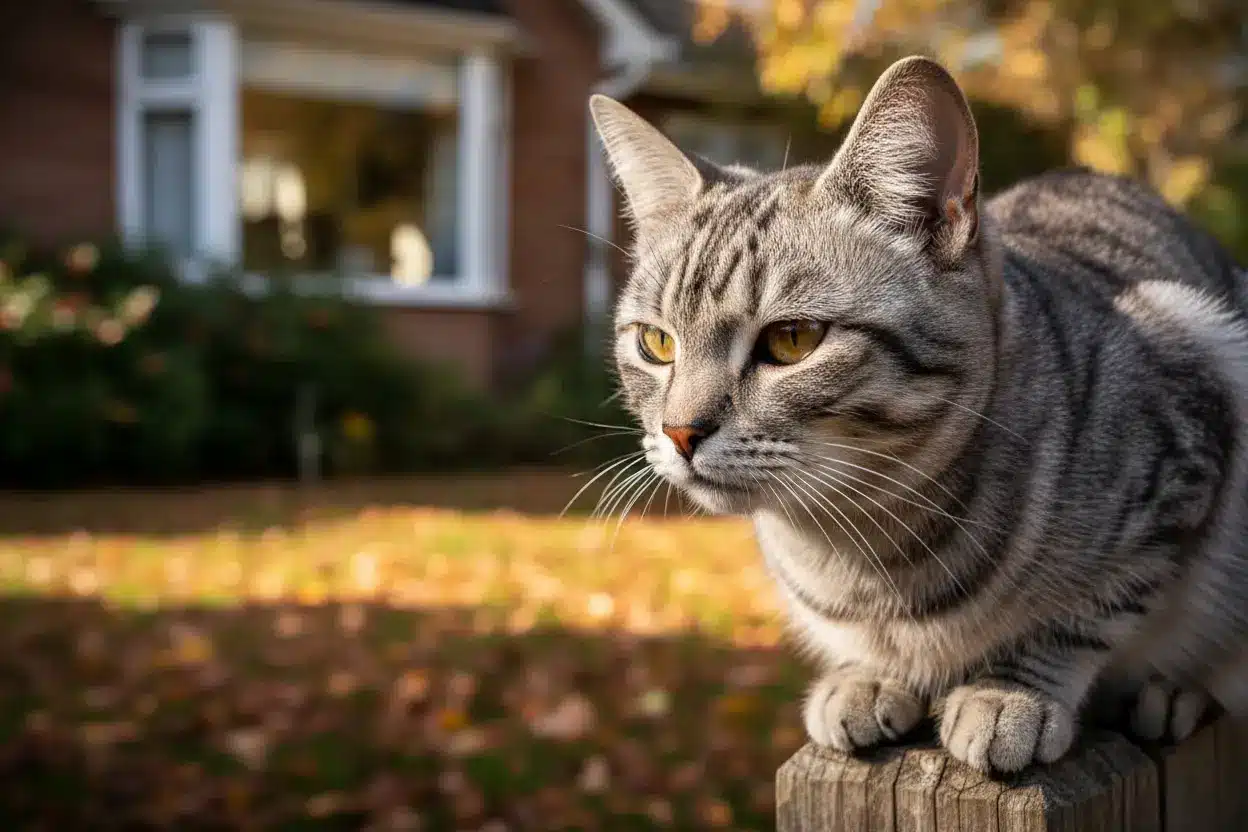
Think your cat only wants you for the fancy kibble? Think again. Science has just pulled back the curtain on our feline companions’ true nature, and it turns out they’re keeping a closer eye on us than we ever expected—yes, even when we’re out of sight.
The Myth of the Indifferent Cat
Let’s be honest: cat owners everywhere have shared the sneaking suspicion that their cats gravitate toward them only when there’s something in it for the feline—namely, easy food. But recent research has put a serious dent in this well-worn stereotype. A 2019 study already showed that our purring friends are much more attached to their humans than we give them credit for. Now, a study published on November 10, 2021, in the journal PLOS One reveals something even more surprising: cats are highly attentive to what you’re doing at home, and they keep track of your location—even when you’ve left the room.
Following in Your Footsteps: Through Walls (and Doors)
The discovery comes from a team of Japanese researchers, led by Saho Takagi from the Department of Psychology at Kyoto University. They examined how cats monitor their owners’ comings and goings—and not with GPS collars or hidden cameras, but through environmental clues. Even when you’re not in the same room, your clever cat is attentively keeping tabs on which room you might be in inside the house. Who needs spy cams when you have feline intuition?
- Cats use environmental cues to know their owner’s location.
- Even if you’re not visible, your cat is aware of which room you’re likely in.
The Experiment That Lifted the Veil
The experimental setup was as simple as it was revealing. The scientists recorded owners calling their cats by name—as well as voices of strangers. They also recorded non-verbal sounds and sounds from other cats. Then, they played these recordings to the feline test subjects and observed each cat’s reaction.
Here’s where it gets fascinating: the cats were clearly surprised when they heard their owner’s voice in the same room as them, especially after having seen their owner leave that room. In other words, when the owner seemingly « teleported » (you know, like in a really low-budget science fiction movie) to a new, unexpected place, the cats didn’t just shrug and walk away. But when the audio stimulus was non-social—like random sounds or noises from other cats—they didn’t react with the same surprise.
- Cats react with surprise to their owner’s voice « appearing » in a surprising location.
- They don’t display the same response to non-human or non-social sounds.
This suggests that even when you’re no longer in the room, your cat is mentally mapping where they expect you to be. According to the researchers, « the results revealed that the cats were surprised when their owner seemed to have ‘teleported’ to a new, unexpected place, but they did not react the same way to non-social stimuli. »
More than that, « these results suggest cats have a mental representation of the invisible owner and map the location of their owner based on their owner’s voice, proving socio-spatial cognition. » Translation? Your cat knows exactly where you are—even when you’re not in sight!
The Feline Mind: More Than Meets the Eye
So what does all this mean for our relationship with cats? For one thing, it’s time to retire the myth of the aloof, self-serving feline. Science shows they care a whole lot more than just about lunchtime—and they’re paying exceedingly close attention to you. It might not look like they’re tuning in, but rest assured, your every move (and your every vocalization) is noted.
As for me, it was probably my father who handed down this passion—a love I, too, hope to pass on to my own children. Whenever I have a moment, I seize the chance to reconnect with nature. And while I love all things related to well-being and ecology, what truly fascinates me is any method—verifiable and reproducible—that expands our understanding. That’s why I’ve chosen to write about these topics, in the hope of sharing some of my knowledge and love for nature with you.
So, next time you slip into another room thinking you’re escaping your cat’s surveillance, remember: those soft paws aren’t the only tools your cat uses to keep track of you. Their minds are just as fine-tuned—and, as science reminds us, maybe even a little bit mysterious.

John is a curious mind who loves to write about diverse topics. Passionate about sharing his thoughts and perspectives, he enjoys sparking conversations and encouraging discovery. For him, every subject is an invitation to discuss and learn.